
The 500% Keyword
Difference
How a two-word phrase swap can determine whether your content gets found or ignored — and what it reveals about data-driven marketing decisions.
Keyword research is one of the highest-return activities in digital marketing. Done well, it tells you not just what people are searching for, but how they think about what they want. A single word choice can be the difference between page one and page five.
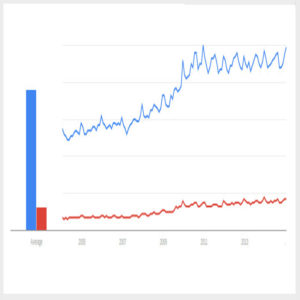
The data below makes that point with unusual clarity. Two phrases. Same intent. A 500% gap in search volume.
Why Keyword Choice Matters
Marketers typically approach keyword research by identifying which terms are searched most frequently, then optimizing content around those terms. The logic is sound: rank for what people are actually looking for. Content marketers apply the same principle to topic selection and headline writing.
What gets overlooked is how much variation exists within the same intent. Two phrases that mean the same thing to a human reader can perform completely differently in search. The gap is not always small.
The Study
We analyzed 40 search terms drawn from the tourism industry. Every term followed one of two structural patterns: phrases beginning with "top 10..." and phrases beginning with "10 best...". The subject matter was identical across both sets. Only the opening phrase differed.
The chart below plots Interest Over Time for both groups, correlated across the full data set.

What the Data Shows
Terms beginning with "top 10" consistently outperformed their "10 best" counterparts by more than 500%. To most readers, these phrases are interchangeable. To a search engine's index of actual user behavior, they are not even close.
This is not an argument for gaming language. It is an argument for measuring it. Without data, a content team might reasonably write "10 best places to visit in Montana" and consider it well-optimized. With data, they would know that "top 10 places to visit in Montana" captures five times the audience for identical effort.
"Subtle changes in terms and keywords can make a dramatic difference in performance. Use data to drive the decision, not intuition."
The Bottom Line
Keyword intelligence is not just about finding high-volume topics. It is about understanding exactly how your audience phrases their intent, down to the word level. The difference between "top 10" and "10 best" looks trivial on paper. In search volume, it is a 5x multiplier on reach.
Before you publish, check the data. The right phrase is rarely the one you assumed.
The content that gets found is not always the best content. It is the content that speaks the language your audience actually uses when they search.
Analysis based on Google Trends Interest Over Time data across 40 tourism-category search terms. Comparison limited to phrase-initial variation ("top 10" vs "10 best") with all other variables held constant.