
Facebook Users Are
Pulling Back
New Pew Research data shows a significant share of Facebook users have adjusted their privacy settings, deleted the app, or stepped away from the platform entirely — with real consequences for advertisers.
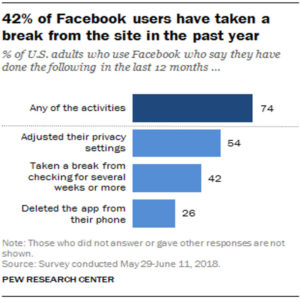
Facebook users are not just complaining about the platform — they are leaving it, locking it down, and deleting it from their phones. A new Pew Research Center survey puts hard numbers on a behavioral shift that has been building for some time.
The data is drawn from a survey of U.S. adults conducted May 29 through June 11, 2018. The findings are significant for anyone relying on Facebook as an advertising channel.
What the Data Shows
Just over half of Facebook users ages 18 and older (54%) say they have adjusted their privacy settings in the past 12 months. Around four in ten (42%) say they have taken a break from checking the platform for several weeks or more, and around a quarter (26%) say they have deleted the Facebook app from their phone.
Taken together, 74% of Facebook users report having taken at least one of these three actions in the past year. That is not a fringe behavior — it is the majority of the user base signaling discomfort with the platform.
Younger Users Are Leading the Retreat
Age differences in this data are sharp. Among users ages 18 to 29, 44% say they have deleted the Facebook app from their phone in the past year — nearly four times the rate of users 65 and older (12%). Younger users are also far more likely to have adjusted their privacy settings: 64% of 18 to 29 year olds have done so, compared with just 33% of users 65 and older.
The one behavior that cuts across age groups evenly is taking a break from the platform. Similar shares of both younger and older users report stepping away for several weeks or more — suggesting disengagement is not purely a generational story.
"74% of Facebook users say they have taken at least one distancing action in the past year. That is the majority of the platform's own audience."
What This Means for Advertisers
The implications for paid social are direct. Fewer daily active users means reduced reach and inventory pressure. More critically, when more than half the audience has adjusted their privacy settings, the data signals that feed Facebook's ad targeting engine become less complete and less accurate.
Lower targeting precision means lower ad efficiency. Brands relying heavily on Facebook for performance marketing should treat this data as a prompt to audit their channel mix — not a reason to panic, but a clear signal that platform dependency carries growing risk.
The Bottom Line
Facebook's scale remains enormous, but the behavioral data points to an audience that is actively managing its relationship with the platform. For marketers, the question is no longer whether this shift is happening — it is how to build strategies that do not depend on it staying the same.
When the majority of a platform's users are pulling back, smart advertisers start diversifying before the numbers force them to.