
The Decline of Facebook
Organic Reach
Since 2014, Facebook has systematically reduced how many people see a business's posts for free. Here is what happened, why it happened, and what it means for brands still counting on Facebook to reach their audience.
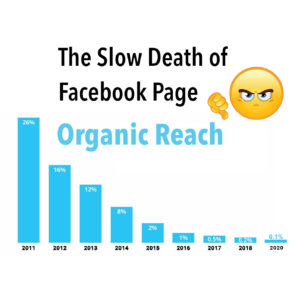
There is a version of this story that a lot of brands are still catching up to. The one where a business built its social media presence on a Facebook Page, invested years in growing a following, and gradually noticed that fewer and fewer people were seeing anything it posted. The audience was still there. The reach was not.
The decline of Facebook organic reach is not a recent development or a temporary algorithm quirk. It is a deliberate, multiyear policy that began in 2014 and has continued in one direction ever since. Understanding what happened, and why, is essential for any business still allocating time and resources to Facebook Page content.
Where It Started
In 2014, Brian Boland, then Facebook's VP of Advertising Technology, acknowledged publicly what brands were already observing in their analytics. Facebook was managing more advertising content than it ever had, and News Feed space was becoming increasingly competitive among marketers. More content competing for the same amount of attention meant less visibility for any individual post, particularly posts from business pages rather than personal accounts.
That explanation framed the decline as a supply and demand problem. More content, finite feed space, lower reach per post. What it did not fully acknowledge was the financial incentive running in the same direction. Every percentage point of organic reach that disappeared was a percentage point that could only be recovered by paying for a boosted post or a paid ad campaign. The decline of free reach and the growth of Facebook's advertising revenue are not unrelated trends.
Facebook still commands the largest user base of any social media platform, with over two billion accounts worldwide. That number is significant, though worth noting alongside estimates that more than 50 percent of those accounts may be fake or inactive. The audience is large. Whether it is as large or as real as the platform metrics suggest is a different question.
What Organic Reach Actually Means
Organic reach on Facebook is the number of people who see a post without any paid promotion behind it. It works on similar principles to organic search rankings, where visibility is earned rather than purchased, though the factors Facebook uses to determine reach are different from those a search engine uses to rank pages.
On Facebook, organic reach has historically been influenced by factors including post popularity, how frequently a page posts, how much engagement previous posts have generated, and how the algorithm weights content from business pages relative to personal posts. All of those factors operate within a system that Facebook controls and adjusts unilaterally, without notice to the pages affected.
The practical consequence is that a business with 10,000 followers on its Facebook Page might expect fewer than 200 of them to see any given post organically. The followers are real. The reach is not proportional to them in any meaningful way.
News Feed Competition
The News Feed is a finite space. As more businesses, brands, and media organizations have created pages and published content, the competition for each available impression has intensified. Facebook's algorithm resolves that competition by heavily prioritizing content from friends and family over content from pages, which means business posts are systematically deprioritized regardless of their quality or relevance to the user who follows the page.
The Pay-to-Play Shift
The decline of organic reach has a direct financial beneficiary: Facebook's advertising business. Every brand that wants to reach the audience it built for free must now pay to do so. Boosted posts and paid campaigns fill the gap that organic reach used to cover. For Facebook, this is not an unintended side effect of improving user experience. It is the business outcome of a deliberate platform policy that converts audience relationships into recurring advertising revenue.
The Official Explanation
Mark Zuckerberg has stated that the reduction in organic reach for pages reflects a desire to build more meaningful connections on the platform. In his words, public content from businesses, brands, and media was crowding out the personal moments that lead people to connect with each other. The platform's stated goal is a feed that fosters genuine relationships rather than one optimized for brand broadcasting. Whether that goal and the advertising revenue outcome are coincidental is a question each marketer should consider independently.
Reach and Engagement Together
Organic reach and post engagement are directly linked. When fewer people see a post, fewer people have the opportunity to like, comment, or share it. As organic reach has fallen below two percent for most business pages, engagement has followed it downward. A page with low reach and low engagement is also less likely to be shown to new audiences, creating a compounding effect where diminished reach leads to diminished engagement, which leads to further diminished reach.
What This Means for Your Strategy
"Building your brand's audience on a platform you do not control means the platform decides how much of that audience you can actually reach."
The strategic implication of sub-two-percent organic reach is straightforward. Posting to a Facebook Page without paid support behind it is unlikely to produce meaningful results for most businesses. The time and resources that go into creating and scheduling that content are not generating proportional return in the form of visibility or engagement.
That does not mean Facebook has no value as a marketing channel. It means the value it offers is now almost entirely tied to paid advertising rather than to the organic relationship between a page and its followers. Brands that understand this and budget accordingly can still reach relevant audiences on the platform. Brands that continue to invest in organic Facebook content expecting the returns that were achievable a decade ago are working against the reality of how the platform operates today.
The broader lesson extends beyond Facebook. Any audience built on a platform owned by someone else is subject to that platform's decisions about how much of the audience a brand can access and at what cost. Owned channels, including email lists, websites, and direct customer relationships, are not subject to the same unilateral policy changes.
Audit Your Current Organic Performance
Pull your page's reach and engagement data for the past 12 months. Establish what your actual organic reach rate is, not what you assume it to be. Most businesses find the number is lower than expected.
Evaluate Your Content Investment Against Return
Calculate how much time and resources go into Facebook Page content each month. Compare that investment against the measurable outcomes it is producing in reach, engagement, and conversions.
Define a Paid Strategy if Facebook Matters to Your Audience
If your target audience is genuinely on Facebook, allocate budget for paid reach rather than relying on organic posts. Treat it as an advertising platform rather than a publishing platform and plan accordingly.
Invest in Owned Channels
Email lists, your own website, and direct customer relationships are not subject to platform algorithm changes. Redirecting some of the effort that goes into Facebook Page content toward building owned audience assets produces more durable long-term results.
Evaluate Alternative Platforms
Other social channels currently offer meaningfully better organic reach than Facebook does. Evaluate where your specific audience is most active and whether those platforms offer a more favorable return on your content investment at this point in time.
The Honest Answer on Facebook's Value Today
Facebook is not a worthless marketing channel. It is a channel whose value has changed fundamentally. The free reach that made a Facebook Page a viable primary marketing tool no longer exists in any meaningful sense. What remains is a large advertising platform with sophisticated targeting capabilities and a user base that, despite its scale, includes a significant proportion of fake and inactive accounts.
Businesses that approach Facebook as an advertising platform, with clear objectives, defined budgets, and measured outcomes, can still get real value from it. Businesses that approach it as an organic publishing channel, expecting that quality content will find its audience, are working against a system that has been deliberately designed to prevent exactly that outcome unless money is involved.
The Bottom Line
The decline of Facebook organic reach is not a trend that is going to reverse. Facebook's leadership has stated explicitly that they believe organic reach for pages is still too high. The direction of travel is clear and has been consistent for over a decade. Planning a social media strategy around meaningful organic Facebook reach is planning around something that no longer exists.
We are not interested in writing off platforms categorically. We are interested in being honest about what each platform actually delivers today, not what it delivered five years ago.
The right response is not necessarily to abandon Facebook entirely. It is to understand precisely what it offers, at what cost, and whether that return justifies the investment relative to the alternatives available. That is a calculation every brand with a Facebook Page should be making with current data rather than historical assumptions.
As organic reach keeps shrinking, brands win by pairing an owned-audience strategy with smart amplification. That’s the thinking behind BriteWire’s online marketing and paid advertising services.
BriteWire is a digital studio based in Bozeman, Montana. We design and build websites, brand identities, and digital systems for clients who care about quality.