
The Decline of the Traditional
Real Estate Brokerage
Traditional real estate brokerages have been spared the disruption that redefined other industries, but that window is closing. Margins are shrinking, top agents are leaving, and market share is in sustained decline.
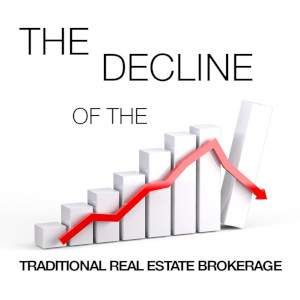
There is a version of this story that plays out in almost every industry eventually. An entrenched business model that worked for decades begins to show cracks. Margins compress. Top performers start leaving. Customers stop caring about the brand. And the companies at the center of it keep telling themselves the disruption is happening to someone else.
Traditional real estate brokerages are in that position right now. The forces reshaping the industry are not speculative. They are visible in the market share data, in the stock prices of publicly traded brokerage franchisors, and in the decisions that top producing agents are making every year about where to take their business.
Disruption Is Not New. The Pattern Is.
Markets under disruption follow a recognizable pattern. A new entrant or technology removes friction from a process that an established intermediary has been charging to manage. Consumers discover they can get the same outcome with less cost or effort. The incumbent loses relevance gradually, then quickly, as network effects and flywheel dynamics accelerate the shift.
The examples are numerous. E-Trade versus traditional stockbrokerages. Expedia versus travel agencies. Amazon versus retail stores. Uber versus taxi operators. Netflix versus Blockbuster and cable television. Airbnb versus the hotel industry. In each case the disruption happened slowly at first, then much faster than the incumbents anticipated once the momentum became self-reinforcing.
Technology disruption follows the same arc. Mobile phones replacing landlines. Open source software displacing closed proprietary systems. Digital advertising taking the revenue base that once sustained print media. The common thread in all of these transitions is not that the legacy business disappeared entirely. It is that the ones that survived did so by reinventing themselves rather than defending a model whose underlying value proposition had eroded. Several boutique travel agencies are thriving today by building deep expertise in specialized segments like fly fishing travel and adventure tourism, having abandoned the general model that no longer worked.
The question for traditional real estate brokerages is whether they are in the early stages of the same pattern, or already past the point where reinvention is straightforward.
Why the Traditional Model Is Under Pressure
For most of the industry's history, real estate brokerages controlled something genuinely valuable: access to information about properties for sale. Consumers needed brokerages because brokerages had the data. That is no longer true. Zillow, Trulia, Redfin, Realtor.com, and hundreds of other platforms give consumers direct access to the same listing information that once required a brokerage relationship to obtain.
The consumer's first step used to be calling a brokerage. Now it is going online, researching properties independently, and then identifying an agent they want to work with based on reviews, track record, and local reputation. The brokerage brand has become almost irrelevant to that decision. The National Association of Realtors reported in 2016 that only 2 percent of consumers chose their agent based on which brokerage they were affiliated with. The other 98 percent chose based on the agent.
The most valuable data in residential real estate is not listing data. It is client and customer relationship data. And that data belongs to the agents, not the brokerages. Agents guard it closely and take it with them when they move. Brokerages have access to transaction and financial data, which has value, but the relationship asset at the core of the business is outside their control.
Declining Margins
Residential real estate brokerages operate on narrow margins in a highly competitive market for top talent. As the options available to top producing agents have multiplied, those agents have successfully negotiated better commission splits, established commission caps, and demanded better office environments and technology investment from their brokerages. Each concession compresses the margin further, and many agents leave anyway.
Top Agents Are Leaving
New brokerage models are competing aggressively for top producing agents. 100 percent commission models, profit sharing models, and hybrid structures all offer better economics than traditional splits. Compass deployed significant capital to acquire market share and positioned itself as a technology company. Independent boutique brokerages give agents direct control over their brand and client relationships. Many of the best agents no longer see a traditional franchise affiliation as worth the cost.
The Brand No Longer Matters to Consumers
Brokerages have spent decades and enormous sums building national brand recognition. That investment is producing diminishing returns. Consumers choose agents, not brands. The brokerage brand an agent is affiliated with has little influence on the transaction. Many brokerages are still actively telling their agents that brand affiliation matters to consumers. The data says otherwise, and the agents who have access to that data are drawing their own conclusions.
Market Share in Sustained Decline
In the Bozeman, Montana market, the six major national real estate brokerage franchises, Berkshire Hathaway, Keller Williams, ERA, Christie's International Real Estate, RE/MAX, and Sotheby's International, have been losing market share consistently for several years. The lack of consolidation among these national franchises is an indicator of a market undergoing not just a gradual transformation but a structural disruption in progress.
Investors Have Already Voted
Realogy, the parent company of Sotheby's International Realty, Coldwell Banker, Century 21, ERA, and Corcoran, traded at a high of $53.53 per share in 2013, valuing the company at over six billion dollars. By 2019 the stock had fallen to $4.93 per share, less than one tenth of its peak valuation. RE/MAX Holdings followed a similar path, falling from a high of $67.20 per share in 2017 to $25.67 in 2019. Franchise fees ranging from $25,000 to $35,000 with ongoing royalties of five to six percent of gross commissions do not command premium valuations when the underlying business model is under structural pressure.
Technology Is Accelerating the Shift
"First the disruption happens slowly, then it happens quickly as network effects and flywheel effects kick in."
Technology is currently empowering individual real estate agents at the direct expense of the brokerage. The best technology solutions in the market today are built for agents and agent teams, not for brokerages. When agents invest in their own marketing platforms, their own customer relationship management systems, and their own digital presence, they take ownership of tools and data that once gave brokerages their leverage. That leverage diminishes with every agent who builds a self-sufficient technology stack.
iBuyer platforms like Opendoor and Offerpad are attacking a different vulnerability: the friction in the traditional selling process. By offering to purchase homes directly from sellers, they remove many of the pain points associated with listing, showing, and negotiating a sale. This model does not require a traditional brokerage at all.
At the far end of the horizon, researchers at Oxford University estimate that artificial intelligence has a 97 percent probability of eventually replacing real estate brokers entirely. That figure may or may not prove accurate, but the direction of pressure it describes is consistent with what is already visible in the market. Gary Keller, founder of Keller Williams, said in 2018 that real estate brokerages had less than five years to fundamentally redefine themselves. That deadline has passed.
Deliver Real Value to Agents
The brokerages that survive will be the ones that give agents a compelling reason to affiliate beyond name recognition. Technology infrastructure, marketing support, lead generation, and genuine business development resources are what agents now evaluate when choosing where to work.
Deliver Real Value to Consumers
Consumers no longer see the brokerage as a meaningful part of the transaction. Brokerages that want to change that perception need to develop services and capabilities that genuinely improve the experience of buying or selling a home, not marketing campaigns asserting that their brand matters.
Invest in Technology That Agents Actually Use
Brokerages investing in proprietary technology platforms need to build tools that top agents prefer over the independent alternatives available to them. If the technology does not reduce friction and improve agent productivity in measurable ways, it will not retain top talent regardless of the investment behind it.
Develop a Viable Agent Economics Model
Commission structures that made sense when the brokerage controlled access to listings and consumer relationships no longer reflect the value the brokerage actually contributes. Brokerages that develop more equitable and transparent compensation models will retain agents that alternatives would otherwise attract.
Consider the Independent Model
Many of the most successful agents operating today are doing so independently or within small cooperative arrangements with other top performers. The independent brokerage model offers greater agility, full control over the transaction process, and the ability to respond to market changes without the overhead of a franchise structure.
The Honest Answer on Where This Goes
The outcome of this disruption cycle is not predetermined. It is not a zero sum game. Traditional brokerages can survive and even thrive if they are willing to genuinely reinvent their value proposition rather than defend the one they have. The travel agencies that thrived after Expedia disrupted the industry were not the ones that argued the old model was still valid. They were the ones that identified what they could genuinely do better and built around that.
The brokerages most at risk are the large national franchises whose value proposition rests primarily on brand recognition and historical market position. Both of those advantages are eroding. The ones with the best chance of navigating the transition are those that move quickly toward genuine agent and consumer value, invest in technology that agents actually choose to use, and structure their economics to compete with the alternatives that top producing agents are increasingly choosing instead.
The Bottom Line
Traditional real estate brokerages are facing the same pattern of disruption that has already reshaped stockbrokerages, travel agencies, retail, and transportation. The data from local markets, the stock prices of publicly traded franchisors, and the decisions of top producing agents are all pointing in the same direction. The question is not whether the disruption is real. The question is whether brokerages will respond to it before the window for reinvention closes.
We are not interested in predicting which brokerages will survive. We are interested in the underlying forces, because those forces determine what a competitive real estate company needs to look like going forward.
Having studied market disruption across multiple industries for over two decades, the one consistent observation is that the slow phase of disruption is always followed by a fast one. The market share data in residential real estate suggests the slow phase is already well underway.
BriteWire is a digital studio based in Bozeman, Montana. We design and build websites, brand identities, and digital systems for clients who care about quality.