
DuckDuckGo Is Growing Fast — Here's Why It Matters
The privacy-first search engine just crossed 30 million daily searches. As trust in Google and Facebook erodes, users are voting with their clicks.
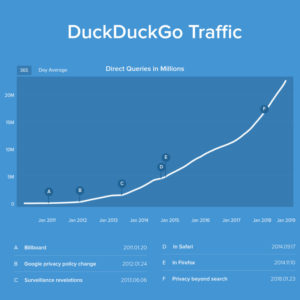
It took DuckDuckGo seven years to hit 10 million daily searches. Two more years to reach 20 million. Less than a year after that, it crossed 30 million. That acceleration is not a coincidence — it reflects a shift in how people think about who has access to their data.
If you haven't heard of DuckDuckGo yet, you will. The search engine operates on a simple premise: your searches and IP address remain completely anonymous. In an era of mass data harvesting, that proposition is resonating.
Still Small, But Moving Fast
To put DuckDuckGo's scale in context: Google processes over 3.5 billion searches per day. DuckDuckGo's record of 30,602,556 daily searches makes it less than 1% of Google's volume. By raw numbers, it's a rounding error.
But compare it to Bing, and the picture changes. DuckDuckGo's daily search volume now sits at roughly one quarter of Bing's — a significant milestone for a company with just 40 employees and a name that still makes people do a double take.
Why Users Are Switching
The shift toward DuckDuckGo is not driven by a better algorithm or a slicker interface. It is driven by distrust. Google and Facebook have built enormously profitable businesses on the back of user data — and more people are starting to understand exactly what that means for their privacy.
This week Google confirmed it had been hacked, exposing the private data of up to 500,000 users. The breach — which went undisclosed for months — prompted Google to announce the shutdown of Google+. It is the kind of event that turns casual concern into real action.
No Search History
DuckDuckGo does not store your search queries or link them to a profile. There is nothing to sell, subpoena, or leak.
No IP Tracking
Your IP address is never logged. Unlike Google, DuckDuckGo cannot build a location history or cross-reference your activity across sessions.
No Filter Bubble
Because DuckDuckGo does not personalize results based on past behavior, every user sees the same results for the same query — no algorithmic echo chamber.
The Bigger Picture
Google is not going anywhere. Its scale, infrastructure, and network effects are enormous. But the assumption that users will simply accept surveillance in exchange for convenience is being tested — and companies like DuckDuckGo are proof that a real alternative audience exists.
As data breaches, censorship concerns, and privacy regulation continue to make headlines, the market for trustworthy search is only going to grow. DuckDuckGo's trajectory suggests it intends to capture as much of that market as possible.
It took seven years to reach 10 million daily searches. It took less than one year to go from 20 million to 30 million. That curve is not slowing down.
Sources: DuckDuckGo traffic statistics via duckduckgo.com/traffic. Google+ breach disclosure, Wall Street Journal, October 2018.