
Half of Facebook's
Users Are Fake
A new report suggests up to 50% of Facebook's two billion accounts are fake or duplicates — and the company has been misrepresenting the scale of the problem for years.
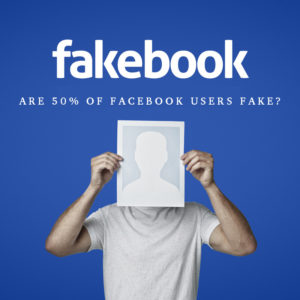
It is widely accepted that a large portion of accounts on Facebook are fake — and that a large portion of ad budgets spent on the platform are worthless, consumed by click-fraud farms. But the problem may be bigger than anyone thought.
Following Facebook's disastrous 2018, a report released January 24, 2019 suggests as many as half of Facebook's two billion accounts are fake or duplicates.
What the Report Says
According to researcher Aaron Greenspan, the platform's measurement of its user base isn't — and will never be — precise enough. The metrics Facebook reports are structurally overestimated.
"Facebook has been lying to the public about the scale of its problem with fake accounts, which likely exceed 50% of its network. Its official metrics — many of which it has stopped reporting quarterly — are self-contradictory and even farcical. The company has lost control of its own product."
The report includes a disclosure noting that Greenspan owns FB put options and entered into a confidential settlement with Mark Zuckerberg and Facebook in 2009. Readers should weigh that context accordingly. The underlying data, however, draws on Facebook's own self-reported figures — and the contradictions are difficult to dismiss.
Greenspan further accused the company of selling ads to "hundreds of millions of phantom buyers — users who do not actually exist."
Why Fake Accounts Thrive
The fake accounts identified in the report aren't just padding numbers. According to Greenspan, they "often defraud other users through scams, fake news, extortion, and other forms of deception" — and frequently "involve governments."
The core problem is structural. How does any social media platform verify a real identity from a fake one? The only credible method is a process similar to opening an online bank account — one that requires meaningful identification. Facebook has never implemented anything close to that standard.
If you use Facebook, you have almost certainly received a friend request from an account with no photos, no posts, and no engagement. That is a fake account. Fake accounts are big business, and Facebook is not doing enough to stop them.
Phantom Ad Buyers
Fake accounts don't just inflate follower counts — they consume advertising spend. When Facebook sells impressions to accounts that don't represent real people, advertisers are paying for nothing. There is no product, no purchase, no conversion on the other end.
Inflated View Counts
Facebook's definition of a "view" is not what most advertisers assume. A promoted video that generates 40,000 views but zero phone calls isn't a campaign that underperformed — it's a measurement system that misrepresents reality. The view counts are exponentially inflated relative to genuine human attention.
Click Farms
Behind many fake accounts are organized click farms — operations that generate artificial engagement at scale. These farms simulate real user behavior well enough to pass Facebook's own detection systems, siphoning ad budgets while delivering no genuine audience reach.
Unverifiable Metrics
Facebook has quietly stopped reporting several key quarterly metrics that would allow independent verification of its user counts. The figures it does report contain internal contradictions that no credible third party has been able to reconcile. The platform is, in effect, asking advertisers to trust numbers it cannot prove.
What It Means for Advertisers
The implications are straightforward: if half of Facebook's user base doesn't exist, then a substantial portion of every dollar spent advertising on the platform is wasted — not underperforming, wasted. There is no user on the other end of the impression.
This is not a fringe concern. It is a structural problem baked into how Facebook counts its audience and sells access to it. Until the company implements real identity verification — which would require the kind of friction that conflicts directly with its growth model — the problem cannot be solved from within.
The Bottom Line
Facebook cannot be fixed without new senior leadership and a fundamental rethinking of how it verifies identity. A platform built on accurate, verified accounts would have a fraction of the user numbers Facebook currently reports — but advertisers could actually trust what they're buying.
A new social media platform is needed: one that demands rigorous verification from the start and continuously monitors for cloned and fake accounts. The user base would be smaller. The trust would be real.
Advertisers deserve to know how many of their dollars are being consumed by click-fraud farms. Right now, Facebook won't give them a straight answer.
In future posts, we will examine specific examples of Facebook advertising campaigns that produced impressive-looking numbers and zero real-world results — including a detailed breakdown of how Facebook counts video views.
Source: PlainSite Reality Check — Facebook (Aaron Greenspan, January 2019). BriteWire is a digital studio based in Bozeman, Montana.